R600m to Police the June 30 Protests: The Immoral Privatisation of South African Safety
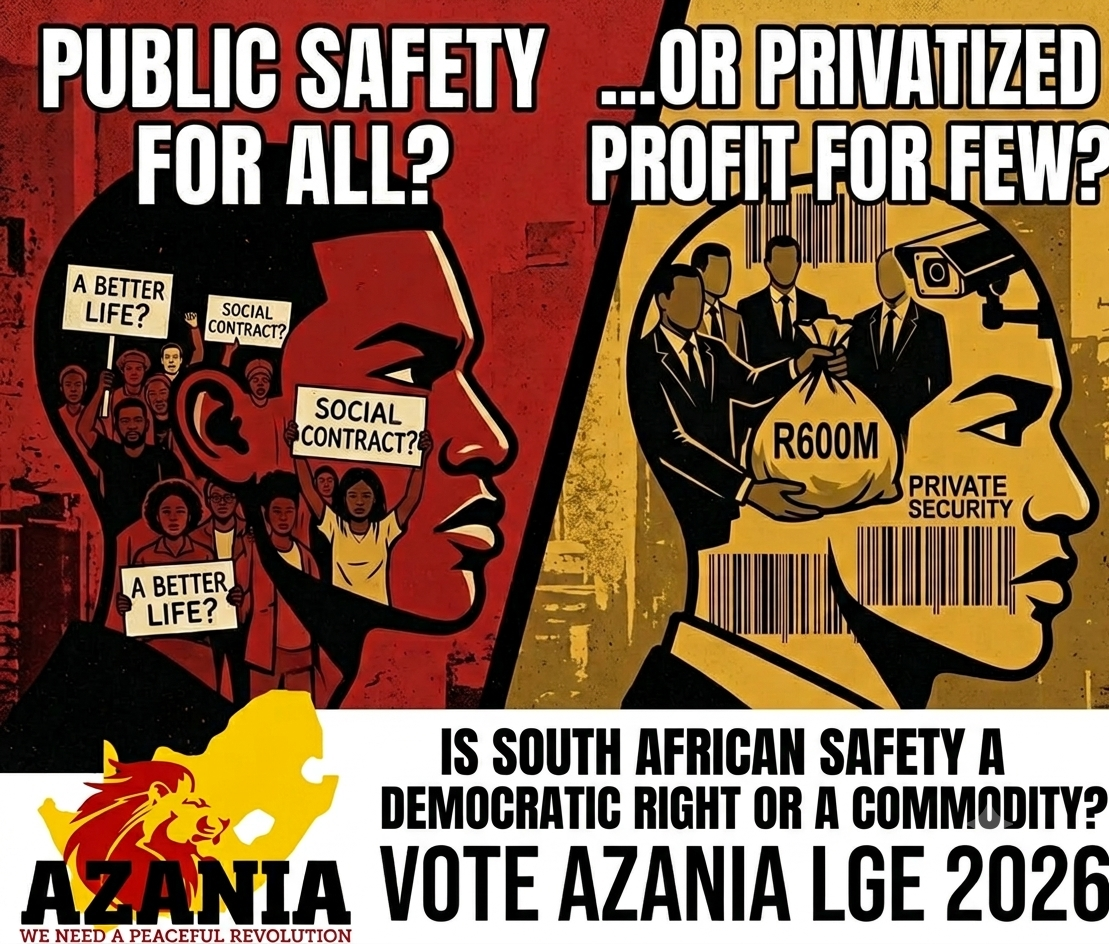
Is South African Safety a Democratic right or a Commodity
The promises of "equality" and "a better life for all" ring increasingly hollow across South Africa. Nowhere is this moral failure more immediate than in the state's response to the anti-immigrant protests scheduled for 30 June 2026. Acting Police Minister Firoz Cachalia’s announcement of an astonishing R600 million emergency security deployment—heavily reliant on collaboration with private security cartels—exposes a terrifying truth: public safety has become a privatised commodity.
This transactional approach to governance fundamentally contradicts the core of republican, democratic constitutionalism. South Africa was founded as a constitutional republic where sovereignty belongs to the people and the state holds a non-negotiable duty to protect the public commons. Outsourcing core functions like security and energy to profit-driven entities (unelected entities) fractures the social contract by turning constitutional rights into market-rate privileges.
Worse still, this dynamic operates directly against the interests of ordinary citizens. Privatising public goods structurally inflates prices, driven by corporate demand for profit margins rather than public welfare. This exploitation mirrors the ongoing crises at Eskom and Transnet, where backdoor privatisation forces citizens to pay skyrocketing tariffs. The Competition Commission's Cost of Living Report highlights the reality: the average worker now forks out over 57% of their monthly earnings solely on basic transport and electricity.
When applied to law enforcement, this model becomes actively dangerous. Privatising policing directly threatens national security, placing the monopoly on violence into the hands of private firms answerable to boards and shareholders rather than the Constitution. This introduces a terrifying threat to fundamental rights and freedoms, as corporate actors lack democratic oversight and are incentivised to suppress dissent to protect capital.
Rather than investing in public institutions, these massive financial rollouts primarily enrich private firms, whose politically connected owners reap the rewards of state dependency. Is this setting a precedent? What we are witnessing is the exact playbook of the Madlanga Commission playing out right in front of our eyes. Just as that commission uncovers how private security tenderpreneurs infiltrate law enforcement to hollow out the state, this R600 million deployment shifts public wealth directly into the pockets of the corporate elite under the guise of an emergency.
This corporate encroachment is out of control; it has extended into our constitutionally guaranteed rights and freedoms. In a deeply coercive overreach, major banks have begun rolling out mandatory Digital ID systems, forcing citizens into a system of compulsory biometric surveillance simply to access their own wealth. Parallel to this, the South African Reserve Bank (SARB) is aggressively developing a Central Bank Digital Currency (CBDC). Shockingly, this seismic overhaul of the financial system is entirely bypassing Parliament. By avoiding legislative oversight, financial cartels are unilaterally implementing a tool capable of total financial surveillance, completely undermining the constitutionally guaranteed rights to privacy, financial autonomy, and freedom.
When access to physical survival, freedom, and basic utilities is dictated by corporate wealth, the democratic promises of equality, freedom, privacy and dignity are dead. Privatising the commons legalises exploitation, driving economic stagnation and leaving the ordinary citizen completely vulnerable and priced out of existence.
— The Azanian